Showing posts with label Law. Show all posts

Thursday, July 02, 2009

Reference Universe - Worth A Second Look

It is easy to overlook, but Reference Universe is vastly improved in content and searching. For example, a search on Irrigation was slow. Two years ago, this subject search allowed you enough time to 'go for a cup of coffee and come back to get results finally...' to now being WOW... I can say supercalifragilisticexpialidocious and get 10 citations on "irrigation" before getting to the "cious" part of the word -- Reference Universe is FAST.

There is a higher level of detail in Reference Universe then the regular ibistro catalog for hard to answer questions using print resources and it even has a few electronic resources we have access to.

Database content...
- 20,000 works from print and e-resource form with table of contents and index citations, 100's recently added just in June alone....
- Prominent publsher with the books in our collection from Gale, Greenwood, Springer and others..
- Patrons stumble upon seredipitous/useful facts to what they are looking for...

Keys to searching the database well...
- Use the browse searching if your unsure how to search. It functions similiar to catalog subject search.
- Use of phrase searching is the main way to use the databae.
- Use of "and" or "or" boolean searching in a strict sense does not work -- think phrase searching.

Things to watch for while searching...
- Each result should be checked for a title availability searching in Ibistro. Due to ISBN linking, format, and edition problems e-resources/books we do have in the collection say (prior editions) to links in database might not show up in Ibistro eventhough it is on the shelf or available online.
- AccessScience/GVRL direct full-text links within the database recently went down... we are hoping to restore these soon.
- If a title sounds to scholary for a public library, we probably don't have it -- try ILL or CofC if this is what the patron wants and it seems there is NO alternative for the needed info...

Thursday, March 26, 2009

Job Hunting Resource - Part 4 Furthering Your Education

This is the forth post in a series on Job Hunting and the South Carolina Pathways.org website. Previous posts on the topic are available in 1, 2 and 3. Are you looking at continuing your education in a degree or non-degree program? The Kuter “Considering Education or Training” section may help.

The education or training component covers degree and non degree programs for further areas of study you may want to consider. The schools profiled in detail are based on in person classroom settings or online throughout the United States, military installations and US territories. Various tabs such as “name and location”, “school and campus characteristics”, “programs and majors” and “admissions and costs” all allow a person to narrow there list of schools down by various criteria in one search list combined in a “see list” format.

Overall, the Kuter education component is very useful in considering furthering your education, tuition costs, application process and other preferences associated with selecting a school of your choice and desired education outcomes.

Saturday, February 28, 2009

The Job Hunting Resource Helps Statewide...

A new resource is available for South Carolina residents looking for a job change, wanting directional help in their job search or returning to the workplace after an abscence. The SC Pathways website, which is powered by Kuder skills assessment testing and paid for by various state agencies/organizations, for SC residents is available to adults, students of all ages and businesses for people to find jobs that interest them and businesses to find employees. In the next series of posts, I'm going to cover the four main components of the Kuder resource. Keep in mind this product does require a registration process that takes a few minutes. SC Pathways is available for just SC residents and residents of other states who have paid access to the the following:

Skills/Interests Assessments Section
Occupational Interests
Education or Training Considerations
Getting Ready for the Job Search
= Creating Resumes Online
= Finding Employers

Note: SCOIS at this time is not available as part of SC Pathways for adults, but is available to most students state wide through individual schools.

Saturday, November 08, 2008

Hathi Trust Ditigal Library - Great Ebooks Online


The Hathi Trust provides a combined collection of public domain/content restricted titles from primarily academic libraries in ebook form online. According to the Hathi website on November 8th, 2008, there are approximately 353,000 titles like Charleston Furniture 1700-1825 which are publicly available online, while approximately an additional 2 million are online with digital rights management restrictions. The Hathi Trust now has a beta ebook search website.

Friday, September 22, 2006

Case Law - An Equally Important 3rd Leg


This article focuses primarily on SC case law and the resources at the Main Library on how to find specific cases on a given topic. Case law is generated from the court systems of federal, state and local level. Case law can be equally as important as Code or Regulations. It may address certain topics not found elsewhere in other forms of law. Keep in mind that this is not legal advice of any kind. Please contact and work with a competent attorney for any legal matter.


As an overview laws are generally generated from the three branches of government and the executive branch generates primarily regulations.

1) Legislative - developed by local, state, and federal governments (sources such as code, public law or statutes). This is the main focus of this blog post.
2) Judicial - developed by actual court cases from municipal, state, and federal courts (sources such as Case Law, US Supreme Court Reporter, South Eastern 2nd case reports, SC Supreme Court Decisions, Appellate Court Rulings, common law system rulings, etc).
3) Executive - sources such as the US Federal Register or the SC Regulations.

The Judicial branch in general generates case law. Case law is generated from actual cases with plaintiffs and defendants in which the matter is aired in court and a judgment rendered. Over time, these cases generally set precedents or case law and can become equally important as the actual law generated by the state house or the governor in the form of regulations.

Researching this area or kind of law, being case law, can get complicated rather fast. One way of researching Case Law on a specific topic is using WestLaws Key Number System found in a few different source we have here at the Main Library being:
South Carolina Digest, South Eastern 2nd Series Reporter.

A person can also research legal topics based on keyword searching within such resources as LOIS LAW database in which text words are used primarily to find legal topics of interest.

SC DIGEST & Descriptive Word Index


The easiest way I can think of explaining this is to think about how Encyclopaedia Britannica Macropedia Works. It is an index to various topics and related topics
that will refer you to possibly 1 to say 10 different articles on a specific or very broad topic in one or more volumes within the encyclopedia set.

WestLaw has a publishing system that takes the majority of all subjects into an index and then is coded with key numbers. The South Carolina Digest is similar to the Encyclopedia Britannica Macropeadia indexing various Britannica volumes.
However, the Digest is the key to cases and without using the digest, the keyword index, or having a specific citation finding relevant case law among the hundreds of volumes of a Reporter of cases is extremely difficult!

STEPS ONE -- FIND THE RELEVANT DESCRIPTIVE WORDS to SUBJECTS -

The South Carolina Digest: Descriptive Word Index (Ready Ref 3418.026) -
is usually a good way to start to look for cases based on keywords of interest on a legal matter. Look to the end volume numbers of the set to find the Descriptive Word Index titles. The SC Digest Descriptive Word Index is organized in alphabetical order. It provides numerous see also like references as to how a topic may be grouped or divided within the SC Digest.

STEP TWO -- FIND RELEVANT HEADNOTES OR CITATIONS WITHIN BROAD SUBJECT AREAS ALPHABETICALLY

a) WestLaw Print Sources -
The South Carolina Digest (Ready Ref 3418.026) - The digest is also in alphabetical order based on major topics. These topics are then grouped into sub topics or areas of the law.

For example, a digest may provide several cases dealing with Liens and numerous lien related topics dealing specifically with Homesteads all grouped together. The notes provided are generally described as headnotes. These headnotes may provide major or specific points dealing with a case that set case law precedents or was important
for one reason or another. Most of the time, these headnotes will refer to a slip opinion which gives even greater detail about a case or a citation such as 134 S.E.2d 569 or 3 S.C. 412 as there are various kinds of citations for cases... More on this later in the next section. Some slip opinions can be found when available in the following sources.

Note: Some folks may go directly to a the Digest and bypass the Descriptive
Word Index. The caution is that the Descriptive Word Index may provide valuable see also like references that might be missed using different terminology and could be crucial to the topic being research.

STEP THREE -- FINDING THE SLIP OPINION
a) LOIS Law Database Source -
This database primarily uses keywords to retrieve results. It does not use the West Law Key System. This database has select South Carolina Supreme Court and Applette Court Cases in slip opinion form. If you know of the specific citation for the SC Supreme Court or Appelete Court you can search for the slip opinion with that citation as well and the ruling will come up when available in the database.

b) West Law Print Sources -
South Eastern Reporter (Ref 345.415 Southea) - This set contains hundreds of volumes of cases within the Southeast covering SC, GA, NC, VA, and WV. The cases in these volumes have been deemed important. The key is to take the citation such as: 134 S.E.2nd 569 and break it down. A Majority of case law citations will use this form.

134 - Volume Number on Spine
S.E.2nd - Source is the South Eastern Reporter: Second Series
569 - Page Number

FINAL NOTE -- SHEPARDING CASE LAW
In a nutshell sheparding of case law is done to determine if the case law or precedent is still valid. Case law can change over time for a variety of reasons. The sheparding of case law is beyond the scope of this article. Here are two of many sources used for Sheperding case law.

Shepards South Carolina citations : cases a compilation of citations...
Call Number: Ready Ref 340 Sou

Shepard’s acts and cases by popular names: federal and state
Call Number: Ref 348.7348 Shepards

Thursday, September 14, 2006

Regulations and Registers - The Law in Motion


This article focuses primarily on regulations and registers generated from various executive level offices. Keep in mind that this is not legal advice of any kind. Please contact and work with a competent attorney for any legal matter. Many times, a form of law may appear in a register before it becomes official law in regulation form.


As an overview laws are generally generated from the three branches of government and the executive branch generates primarily regulations.

1) Legislative - developed by local, state, and federal governments (sources such as code, public law or statutes). This is the main focus of this blog post.
2) Judicial - developed by actual court cases from municipal, state, and federal courts (sources such as Case Law, US Supreme Court Reporter, South Eastern 2nd case reports, SC Supreme Court Decisions, Appellate Court Rulings, common law system rulings, etc).
3) Executive - sources such as the US Federal Register or the SC Regulations.

The largest volume of regulations generated generally comes from the federal and state level.

FEDERAL LEVEL
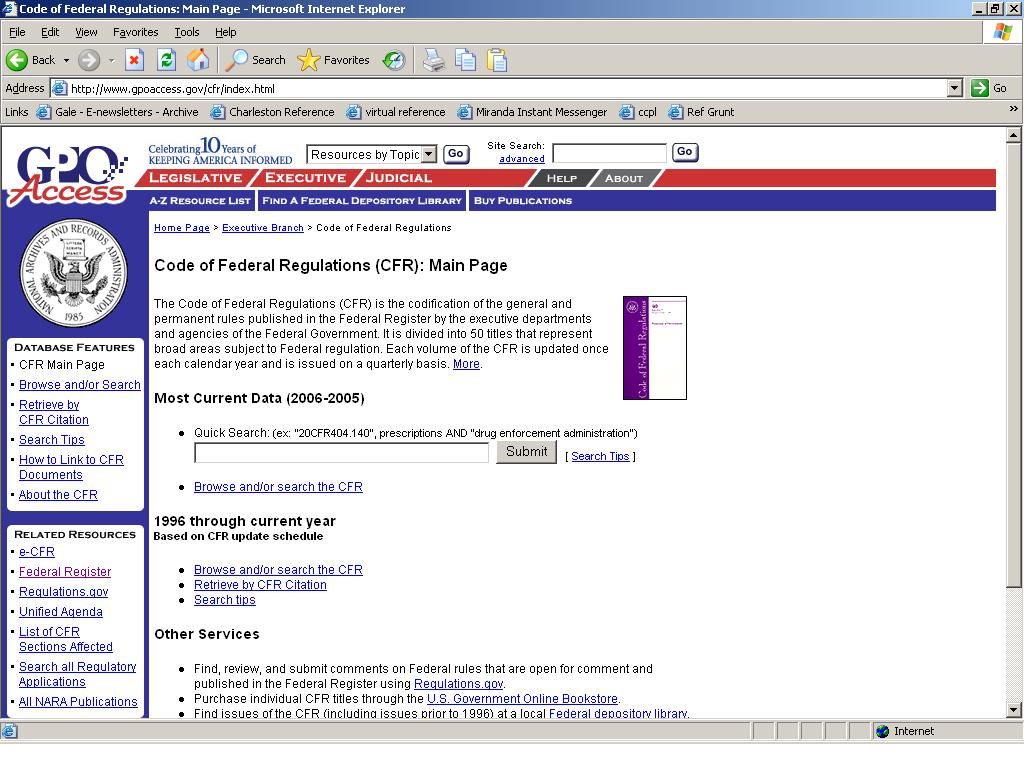
The Code of Federal Regulations publishes about 50 different titles on topics such as: energy, animals, banks and banking, commercial practices, food and drugs, labor; navigation and navigable waters; patents, trademarks, copyright and other
areas…

The Government Printing Office - Code of Federal Regulations
Code of Federal Regulations

The Federal Register as described by the Government Printing Office website states that this contains the official daily publication for rules, proposed rules, and notices of Federal agencies and organizations, as well as executive orders and other presidential documents. More information about the Register in general is available at:

The Government Printing Office - Federal Register
Federal Register

SC STATE LEVEL
The South Carolina Code of Regulations contains about 140 Chapters concerning various topics such as the Building Codes Council, State Budget and Control Board, farming regulations, labor, motor vehicles; labor and licensing; retirement, minority affairs, and other topics of interests.

The SC State house maintains a website with
SC Code of Regulations

The Main Library has a print set of the SC Code of Regulations in the Ready Reference Section.


South Carolina Register
The flowing comes directly from the South Carolina State Register in describe content found within the Register.

"
Notices are documents considered by the agency to have general public interest.
Notices of Drafting Regulations give interested persons the opportunity to comment during the initial drafting period before regulations are submitted as proposed.
Proposed Regulations are those regulations pending permanent adoption by an agency.
Pending Regulations Submitted to the General Assembly are regulations adopted by the agency pending approval by the General Assembly.
Final Regulations have been permanently adopted by the agency and approved by the General Assembly.
Emergency Regulations have been adopted on an emergency basis by the agency.
Executive Orders are actions issued and taken by the Governor.
"

The Main library has a print set of the SC State Register from 1999 to 2002 in the South Carolina Room. A historical version with past issues from the 1999 to June of 2002 are available at: South Carolina State House Website
Back Issues of SC State Register


There is a current online version of this publication, but there are fees associated with obtaining content from other websites. The College of Charleston, the Citadel, Charleston Southern University, and Trident Tech do not have a current subscription to this resource either.

LOCAL LEVEL
Each village, town of incorporation or un-incorporation, and city works differently and may or may not have local regulations or other forms of law generated by an executive of local government. It depends on the form of municipal government as sometimes legislation may have numerous readings before it becomes enforceable as law.

Friday, September 08, 2006

Code of Laws or Statutes : From Local to Federal Level


This article focuses primarily on legislative law such as code of laws or statutes and public law bills. Keep in mind that this is not legal advice of any kind. Please contact and work with a competent attorney for any legal matter. The following is just a general overview of the kinds of legal materials available online and in print forms. Usually, there are three kinds of laws that are generated by government:


1) Legislative - developed by local, state, and federal governments (sources such as code, public law or statutes). This is the main focus of this blog post today.
2) Judicial - developed by actual court cases from municipal, state, and federal courts (sources such as Case Law, US Supreme Court Reporter, South Eastern 2nd case reports, SC Supreme Court Decisions, Appellate Court Rulings, common law system rulings, etc).
3) Executive - sources such as the US Federal Register or the SC Regulations).

ORGANIZATION & PRESENTATION of CODE
Legislation that is passed by legislative bodies such as a town, city or county council; state legislative bod(ies) process; or congress and the possible consent of the president on the federal level are generally considered legislative law. Generally speaking public law is put into statutes or code to make it easier to research. Usually a governmental body will designate an official version of the code, case law, or set of regulations when more than one version exists the official version is the authority on the laws.

The code of laws, also known as revised statutes in some states, are a compilation of all public bills passed by a legislative body. Generally speaking the code of laws is built upon public laws passed over time and placed into a more user friendly format. The code of laws may come in various forms such as: non annotated (public law bills grouped by subject) or annotated (may include case law, attorney general opinions, historical footnotes, references to jurisdictions, and a variety of other kinds of information when available and applicable sometimes). The annotated version provides a greater amount of depth on a topic.

Note: Some codes may be searchable with full text and or are by title and section organization. A code of laws set may refer or defer to other jurisdictions as part of the law.

MUNICIPAL LEVEL
There are a variety of sources for municipal code such as Municode.com, American Legal Corporation or at local government websites code may be include. Some of the larger legal websites provide in many instances the official version of the village, city, or county level municipal code. Not all the cities, towns, or villages within Charleston County have municipal code on websites. These are just a few...

Folly Beach, City of
http://www.amlegal.com/follybeach_sc/

Kiawah Island, Town of (select ordinances on website)
http://www.kiawahisland.org/govt/conc.php

Mt Pleasant, Town of
http://www.amlegal.com/mtpleasant_sc

North Charleston, City of
Code on MuniCode.com

Seabrook, Town of
Code on town website

-- UPDATED Entry on 10/14/06 (SKS)--
Municipal code print versions, such as the Mount Pleasant Code of Ordinances are NO LONGER available at any Charleston County Public Library branches in print form.

STATE LEVEL LEGISLATION
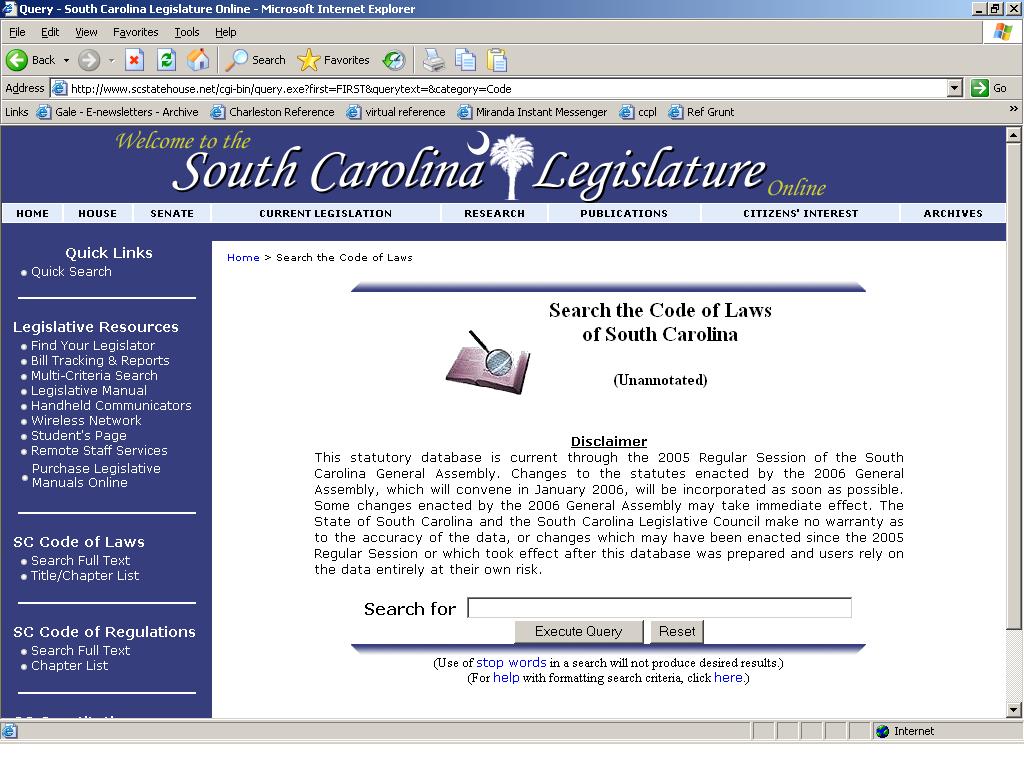
The South Carolina House of Representatives maintains a website on the Code of Laws of South Carolina. Be aware of the disclaimer on the website and in print form noting the date of last update and that statutes enacted may not necessarily be updated on the website or in print form. Currently, the SC State House website also has a note that states "users rely on the data entirely at their own risk."

Currently, a person can search the SC Code by full text or use the title/chapter list option to retrieve results at the SC State House website found at: http://www.scstatehouse.net

We also have the print version of the South Carolina Code of Laws Annotated at the following branches: Cooper River, Dart, Dorchester, James Island, Johns Island, Main Library, Mount Pleasant, Otranto, Saint Andrews, and West Ashley branches currently.

FEDERAL LEVEL LEGISLATION
The United States Code is federal law enacted by Congress and the President. There are generally two forms of the federal code annotated and not annotated.

United States Code
Currently, a person can search by full text or use the title/chapter list option to retrieve results at the Office of the Law Revision Counsel website being:
http://uscode.house.gov It is searchable and down loadable.

United States Code Annotated
The print version at the Main Library is annotated and may contain additional legal information being: historical and statutory notes, cross references, library references, regulations, and notes of case decisions.

Wednesday, July 26, 2006

Power of Attorney Info

Recently, we have had several requests for information and forms related to power of attorney.

I am enclosing some information that may help you if you get similar questions.

The South Carolina Department of Health and Human Services has two related forms, the Health Care Power of Attorney and a Living Will form that can be downloaded and printed out.
DHHS Forms
The forms are on Page 2.

Nolo.com has some good articles on power of attorney.
Click here for articles

Go to Google and type in the words "nolo power of attorney" to access it quickly.

Findlaw's estate section has a Durable Power of Attorney for Finances FAQ
Power of attorney FAQ

I could not find any free South Carolina Durable or Financial Power of Attorney forms on the Web.. There are some available for sale on the Internet, but that's "buyer beware," as always.